Feb 03, 2026
Argentina Soybean Estimate Lowered 1.0 mt to 47.0 Million
Author: Michael Cordonnier/Soybean & Corn Advisor, Inc.
Rainfall last week and over the weekend in Argentina was limited to northwestern growing areas. Warm and dry weather is expected across Argentina through early this week, which will maintain dryness concerns in central and southeastern areas and increase crop stress. Rainfall chances are expected to increase later this week and next week for central and eastern areas.
The conditions in Argentina continue to deteriorate under sunny skies, warm temperatures and a lack of rain. In the core production areas, rainfall was plentiful during October and November, but it turned much dryer during late December and all of January. According to the Rosario Grain Exchange, in the core production area, January rainfall averaged 38 mm (1.5 inches) compared to the normal during January of 100-125 mm (4 to 5 inches).
The hardest hit area appears to be northern Buenos Aires and southern Santa Fe. Of the 36 weather stations in the region, only one registered normal rainfall for January (122 mm or 4.8 inches) while some registered only 9 mm (0.3 inches). Approximately 50% of the core production area is now in drought.
Early planted soybeans in the core region are 35% flowering, 60% setting pods (R3-R4), and 5% filling pods (R5) with reports of dead pants, wilted leaves, fewer nodes, and aborted flowers and pods. Yield losses are already estimated at 15% to 20% with some as high as 50%. Increased pest pressure from spider mites and thrips is also being reported, which is typical under hot and dry conditions.
In regions that recorded the highest rainfall during January, acceptable yields are still possible if additional rainfall is forthcoming. Double crop soybeans still have an opportunity to recuperate because about half of the crop is still in vegetative development with the rest initiating flowering. The forecast for early February offers some hope for a change in the overall pattern allowing for more rainfall, but much of the damage has already been done.
Therefore, the Argentina soybean estimate was lowered 1.0 million tons this week to 47 million with a lower bias. Rainfall during February will be critical for soybeans in Argentina. If the dryer-than-normal pattern persists, the production estimate will continue to move lower.
Soybeans in Argentina were 99.5% planted as of late last week. Approximately 30% of the early planted soybeans in the core production area are entering their critical reproductive stage where rainfall is needed to maintain their yield potential. Double crop soybeans are 16% flowering under limited soil moisture.
Soybeans in Argentina were rated 16% poor, 37% fair, and 47% good/excellent as of late last week. The good/excellent percentage is down 6% from the prior week. Soil moisture for soybeans is rated 36% short and 64% favorable/optimum. The favorable/optimum percentage is down 3% from the prior week. Below is the soybean rating in Argentina for January 28, 2026 from the Buenos Aires Grain Exchange.
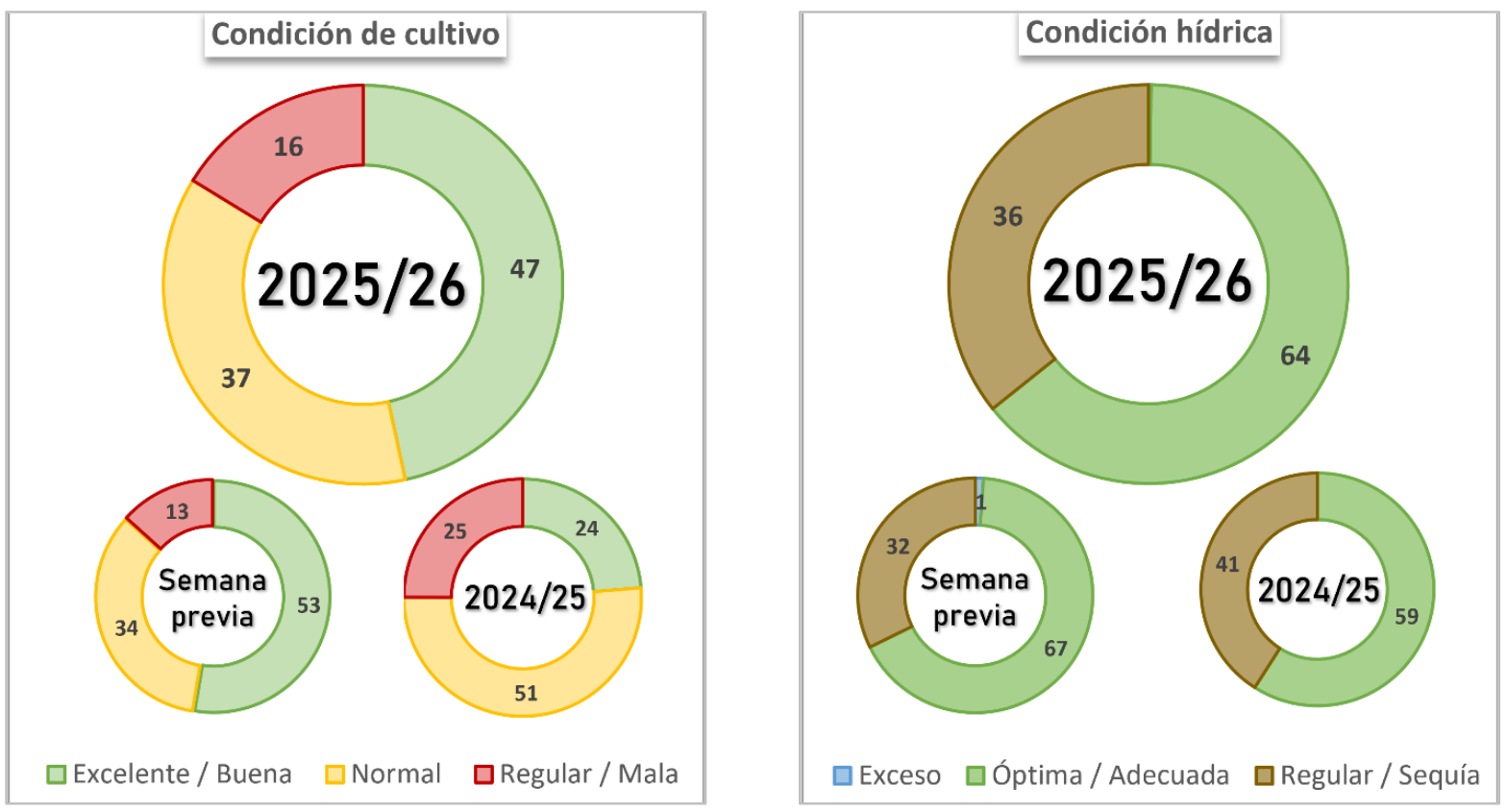
2025/26 Argentina Soybean Ratings*
| Condition | Soil Moisture | |||
|---|---|---|---|---|
| Poor/V. Poor % | Good/Excellent % | Short/V Short | Favorable/Optimum | |
| Dec. 23, 2025 | 1 (1) | 67 (62) | 4 (19) | 96 (81) |
| Dec. 30, 2025 | 0 (1) | 68 (62) | 3 (19) | 97 (81) |
| Jan. 7, 2026 | 0 (7) | 65 (57) | 14 (23) | 85 (77) |
| Jan. 14, 2026 | 4 (18) | 61 (38) | 26 (40) | 73 (60) |
| Jan. 21, 2026 | 13 (24) | 53 (26) | 32 (44) | 67 (56) |
| Jan. 28, 2026 | 16 (25) | 47 (24) | 36 (41) | 64 (59) |
*Source: Buenos Aires Grain Exchange – Crop Condition & Development Stages